

At 10:15 on a Tuesday morning, a production planner learns that a critical component will not arrive on the truck booked for the afternoon. The vehicle is held up, the delivery window has not moved, and the line is still scheduled to run at six.
The problem is no longer that a truck is late. Someone now has to establish what capacity is available, which route can still meet the deadline, whether air freight is justified and who will watch the replacement movement until it is signed for. For time critical freight, this is the point where visibility has to become control.
Why visibility alone is not enough
Logistics teams have never had more shipment data. GPS positions, estimated arrival times, carrier updates and digital platforms can all show where a load is and whether it is moving to plan. Knowing that a shipment is late, however, is not the same as solving the delay.
A logistics control tower combines that visibility with coordination and exception management. McKinsey notes that fully digital control towers strengthen resilience by widening real time monitoring, so teams can anticipate and respond to disruption rather than simply record it.
The distinction matters most when the freight cannot wait. A late standard delivery is an inconvenience. A late production component is a different economic problem, one that shows up as overtime, an expedited replacement or an idle line, as our framework on the total cost of a missed production window sets out. The value of a control tower is therefore not the dashboard. It is the ability to turn information into a decision while there is still time to act.
What happens between booking and delivery
A time critical shipment is better understood as a sequence of decisions than as a single movement.
Booking and capacity. The process starts with the real requirement: origin, destination, deadline, dimensions, weight, and any customs, security or temperature constraints. The question is not which option has the lowest rate, but which available capacity can meet the window with an acceptable level of reliability. At Flash, a digital booking platform connects customers to a vetted carrier network with live availability and pricing.
Dispatch and routing. Vehicle, driver, route and collection time then have to work together. On international lanes the plan may also include border crossings, airport connections, customs and handover points. Technology shortens the gap between a requirement and an executable plan, which is the subject of our analysis of AI in freight dispatch.
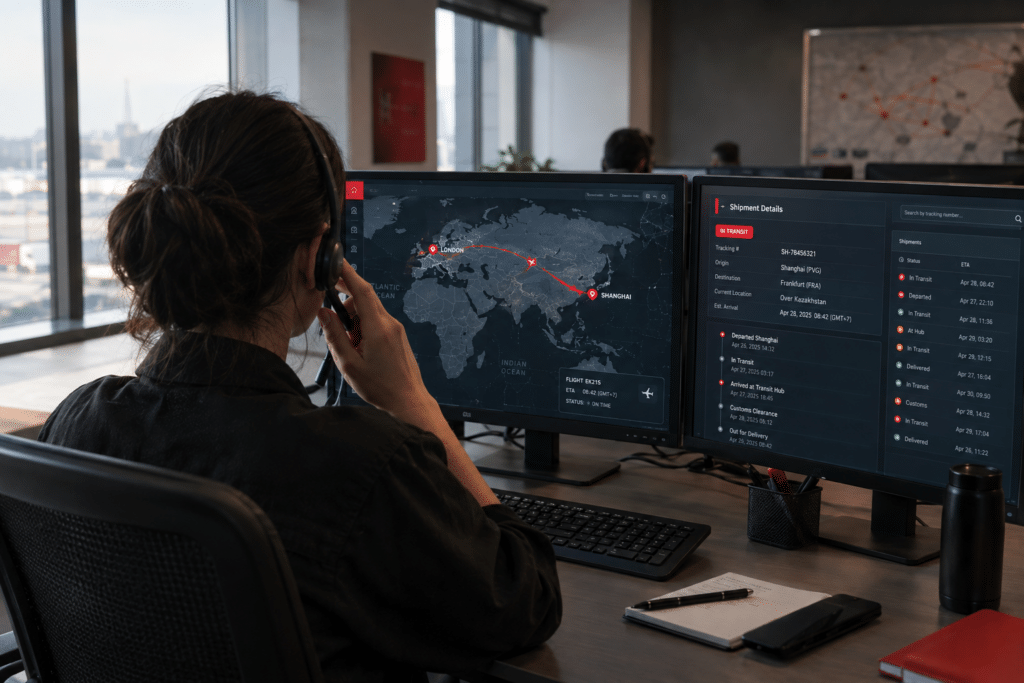
Live monitoring. Once the freight is moving, the control tower shifts from planning to watching for drift. Location, ETA and carrier updates build a picture that changes by the minute. The objective is not to follow a dot on a map. It is to spot the moment the original plan starts to fail.
The critical moment is the exception
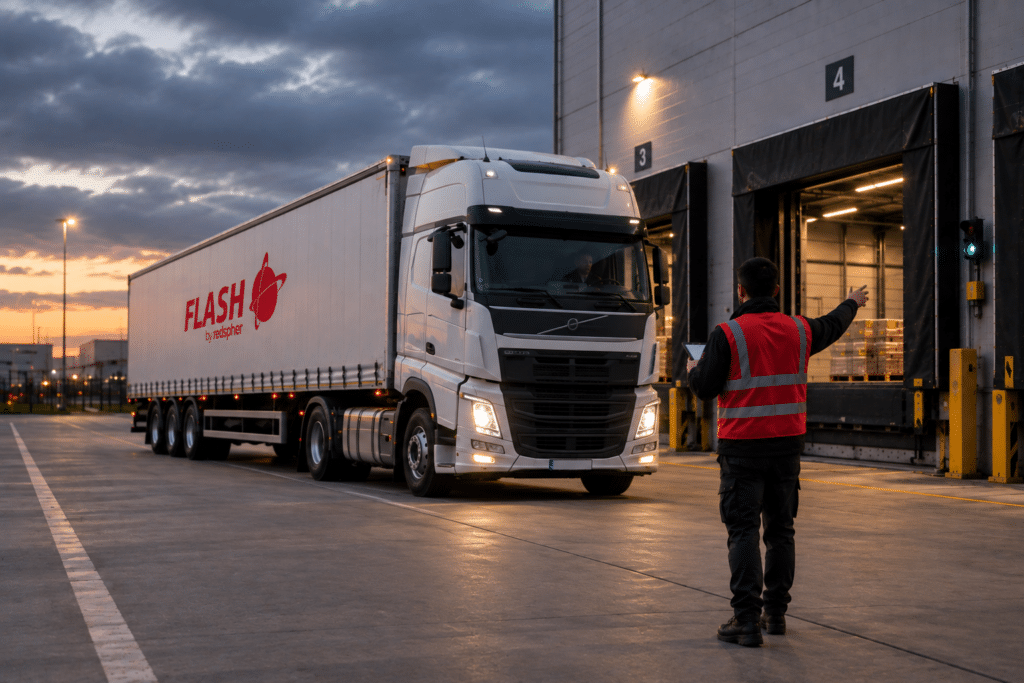
Most urgent shipments do not need the plan rewritten every hour. The value of a control tower shows when something changes: a vehicle breaks down, a flight is cancelled, traffic pushes the ETA past the window, a border crossing slows, a carrier loses capacity or the destination moves.
At that point the shipment is at risk, and the only question that matters is how fast the operation can move from detecting the problem to executing an alternative. That speed counts for more every year. The World Economic Forum's Global Value Chains Outlook 2026 concludes that volatility has become a structural condition of supply chains rather than a temporary shock.
The exception is rarely confined to one vehicle. A truck has to reach an airport, the flight has to connect with an onward movement, customs has to clear before the next carrier collects, and the final vehicle has to arrive inside a plant's receiving slot. Every handover is a potential point of failure, which is why a control tower manages the chain, not just the shipment.
The useful question is no longer which carrier, but which combination of road and air capacity gives this load the best chance of arriving on time. It is the same trade off we explored in Q4 air freight capacity, as belly space tightens ahead of peak season.
Technology accelerates the decision, people own it
A control tower is not an algorithm with a screen attached. Software can track thousands of data points, flag anomalies, recalculate ETAs and rank routing options in seconds. People supply the judgement.
That balance grows more important as AI moves from prediction towards execution. Recent World Economic Forum analysis of agentic supply chains warns that organisations must keep oversight as AI agents take on more decisions. A standard component may be rerouted by a known rule. A sensitive aerospace part, a pharmaceutical consignment or a component needed for a production restart usually calls for direct coordination with the customer. Technology speeds up the flow of information. The operations team decides what it means.
What this looks like in practice
Consider a component moving by road to an automotive plant. The plan is simple: supplier, collection, road transport, plant delivery. Halfway through the journey, a major disruption pushes the ETA outside the production window.
A basic tracking tool reports the delay. A control tower asks different questions. Where is the freight now, and how much time is left before the window closes? Which vehicles or carriers could take over, and where should the handover happen? Would an air leg recover enough time to justify the cost? How will the replacement be tracked, and who needs to know?
The faster those answers arrive, the more options stay open. Flash runs this model through its own agencies and a network of vetted carriers on a shared booking and tracking platform, with a control tower operating around the clock across road, air and multimodal movements.
The road ahead
Supply chains are becoming more connected, but connection alone does not make them responsive. Data creates visibility, and visibility only creates better outcomes when an organisation has the processes, capacity and people to act on it.
For logistics directors comparing providers, the useful tests are operational: how quickly an exception is detected, how much capacity can be reached, whether modes can be combined, how clearly the customer can follow the response and who owns the decision. A shipment can be perfectly visible and still arrive late.
For freight where the cost of waiting is higher than the cost of intervening, the control tower is what separates a contained disruption from one that reaches the production floor. If your critical flows need that level of response, talk to the Flash team.
Frequently asked questions
What is a freight control tower?
A freight control tower is a centralised operational function that monitors shipments, coordinates transport activity and responds to exceptions. It combines shipment visibility with the processes needed to manage disruption and organise alternative solutions.
What is the difference between shipment tracking and a control tower?
Tracking shows where a shipment is and what its status is. A control tower goes further: it monitors the shipment, identifies exceptions and coordinates action when the original transport plan is at risk.
Can a control tower manage road and air freight together?
Yes. A control tower can coordinate several transport modes and the handovers between them. This matters most for time critical freight, where switching between road and air may be the only way to protect a delivery window.
Why is real time visibility important for urgent freight?
Real time visibility gives logistics teams earlier warning of delays and exceptions. The sooner a disruption is identified, the more alternatives remain available before a delivery deadline is missed.
Does AI replace human freight dispatchers?
No. AI can accelerate data analysis, routing evaluation and exception detection, while experienced logistics professionals keep making the decisions that require judgement. World Economic Forum analysis stresses the need for human oversight as AI takes on more supply chain decisions.
How does Flash use control tower capabilities?
Flash combines a digital booking and tracking platform, a vetted carrier network and a control tower operating around the clock. The team monitors shipments, coordinates transport activity and responds to exceptions across road, air and multimodal movements.